
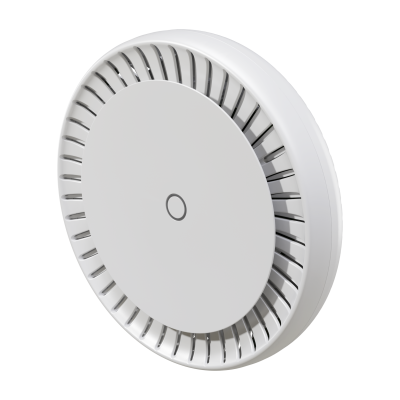


MikroTik cAP LTE12 ax CAT12 Wi-Fi 6 Ceiling AP LTE
The MikroTik cAP LTE12 ax is a CAT12 LTE + dual-band Wi-Fi 6 ceiling access point delivering up to 600 Mbps LTE downlink and 150 Mbps uplink — paired with 574 Mbps at 2.4 GHz and 1,200 Mbps at 5 GHz via 802.11ax, on a quad-core ARM64 IPQ-6010 CPU at 1.8 GHz with 1 GB RAM. 802.3af/at PoE-in and passive PoE-out on Ether2 (22.8W), IP20, WPA3/OWE security, CAPsMAN-ready, RouterOS v7 License 4, -40°C to +50°C. Ceiling-mount design eliminates theft, obstruction, and cable clutter from the workspace. Includes 48V adapter, Gigabit PoE injector, K-81 fastening set, and cAP ax ceiling bracket. The correct single-device LTE + Wi-Fi 6 solution for pop-up businesses, food stands, festival operations, and high-traffic temporary venues.

We only offer IC Certified products. For international products, contact us.

Ship Charge Will Display As Free Until Ship Address / Location Is Provided To Calculate Ship Charge.
The MikroTik cAP LTE12 ax is built for a specific deployment reality: a business operating in a temporary, semi-permanent, or high-traffic public space — a pop-up retail store, a festival food stand, a coffee shop on a patio, a market stall, an outdoor event venue — that needs fast, managed internet connectivity without depending on a fixed broadband line, and without exposing network hardware to the physical risks of a crowded, public-facing environment. The ceiling mount is not a styling choice — it is the entire premise of the design. Devices on tables, floors, and counters get knocked over, misplaced, and stolen. Devices on the ceiling do not. The cAP LTE12 ax is mounted overhead, cabled through the ceiling, and out of reach. The network runs; the hardware stays in place.
The CAT12 LTE modem delivers the uplink performance the Wi-Fi 6 radio demands. LTE Category 12 supports 600 Mbps downlink and 150 Mbps uplink with 4×4 MIMO on the downlink — a significant step above CAT4 (150 Mbps) and CAT6 (300 Mbps) modems commonly found in comparable devices. For a busy venue with tens or hundreds of simultaneous Wi-Fi 6 clients, a weak or narrow LTE uplink is the first bottleneck. The CAT12 modem with 4×4 MIMO eliminates that bottleneck — the uplink can sustain the aggregate throughput demand of a full Wi-Fi 6 client load. The supported LTE FDD bands — 1 (2100 MHz), 3 (1800 MHz), 5 (850 MHz), 7 (2600 MHz), 8 (900 MHz), 20 (800 MHz), and 28 (700 MHz) — cover the primary LTE frequency deployments across European and many international markets. LTE TDD bands 38, 40, and 41 extend coverage to TDD-LTE markets. 3G fallback at Category R8 (42.2 Mbps downlink, 11.2 Mbps uplink) on bands 1, 3, 5, and 8 provides connectivity continuity when LTE is temporarily degraded.
The Wi-Fi 6 (802.11ax) dual-band radio is the performance headline. MikroTik's own figures: up to 40% higher throughput in the 5 GHz band and up to 90% higher throughput in the 2.4 GHz band compared to Wi-Fi 5 (802.11ac) and Wi-Fi 4 (802.11n) — achieved through OFDMA, MU-MIMO, BSS colouring, and Target Wake Time efficiency improvements built into the 802.11ax standard. The 5 GHz radio (802.11a/n/ac/ax, QCN-5022, 2-chain, 5.5 dBi) delivers up to 1,200 Mbps. The 2.4 GHz radio (802.11b/g/n/ax, QCN-5022, 2-chain, 6 dBi) delivers up to 574 Mbps. Both radios are integrated internal antennas — ceiling-mount placement provides near-omnidirectional horizontal coverage across the venue floor below.
Security is enterprise-grade. Wi-Fi 6 introduces WPA3-PSK, WPA3-EAP, and OWE (Opportunistic Wireless Encryption) — encryption standards that prevent brute-force password attacks and deauthentication attacks that are trivially executable against WPA2 networks in public-facing venues. Management frame protection (MFP) is included. For a coffee shop or food stand offering customer Wi-Fi, WPA3 and OWE are not premium features — they are the minimum responsible security standard for a public network in 2024.
Fast transition roaming (802.11r-compatible) allows client devices to switch between multiple cAP LTE12 ax units across a larger venue seamlessly — without re-authentication delays that interrupt video calls, payment processing, or active browsing sessions. For venues deploying multiple access points across a large festival ground, market hall, or multi-room space, seamless roaming is a direct guest experience improvement.
CAPsMAN (Controller AP system Management) integration — MikroTik's wifi-qcom CAPsMAN — allows any MikroTik RouterOS device to centrally manage hundreds of cAP LTE12 ax units from a single controller. SSID configuration, security policy, channel selection, and client roaming policy are all managed from the controller — not individually on each AP. For event companies and venue operators deploying many access points across a site, CAPsMAN reduces setup from hours of per-device configuration to minutes of controller-level policy deployment.
The PoE-in and PoE-out architecture simplifies installation. 802.3af/at PoE-in (18–57V) on Ether1 powers the cAP LTE12 ax from the included Gigabit PoE injector or any standard PoE switch — a single Ethernet cable from the ceiling carries both power and data, with no separate power cabling to the ceiling mount point. Passive PoE-out on Ether2 (up to 57V, 22.8W total, 0.6 A low voltage / 0.4 A high voltage) allows the cAP LTE12 ax to power a downstream device — a network switch, a CCTV camera, a second AP, or a PoE-in sensor — directly from the Ether2 port. For ceiling installations where running additional power cables is impractical, PoE-out eliminates a separate power run for the downstream device.
The compute platform is the most powerful in this product batch. The quad-core ARM64 IPQ-6010 CPU running at up to 1,800 MHz with 1 GB RAM and 128 MB NAND runs RouterOS v7 on License 4 — full RouterOS including IPsec hardware encryption, WireGuard VPN, complex firewall rules, BGP, OSPF, QoS, and remote file sharing. For a pop-up business that needs both internet access and a secure VPN tunnel back to a central office, the cAP LTE12 ax handles the VPN termination on-device — no separate router or VPN concentrator required. Hardware-accelerated IPsec (IPQ-6010 onboard crypto engine) delivers IPsec throughput well above what a comparable MIPS or older ARM device can provide in software. Software updates are included for the life of the product, guaranteed minimum 5 years from purchase.
Maximum power consumption is 34W with attachments (13W without) — the PoE-out load accounts for the 21W difference. The passive cooling design (no fan) eliminates fan noise in quiet environments and removes a moving-part failure mode from the device's operational life. MTBF is ~200,000 hours at 25°C — consistent with the KNOT LR8G and LHG LTE18 in this product batch.
Key specifications:
- **LTE modem:** EG12-EA, CAT12 — 600 Mbps DL / 150 Mbps UL, 4×4 MIMO DL, 1×1 UL
- **LTE FDD bands:** 1 (2100 MHz), 3 (1800 MHz), 5 (850 MHz), 7 (2600 MHz), 8 (900 MHz), 20 (800 MHz), 28 (700 MHz)
- **LTE TDD bands:** 38 (2600 MHz), 40 (2300 MHz), 41 (2500 MHz)
- **3G:** Category R8, 42.2 Mbps DL / 11.2 Mbps UL — bands 1, 3, 5, 8
- **Wi-Fi 2.4 GHz:** 802.11b/g/n/ax, Wi-Fi 6, 2-chain, 574 Mbps max, 6 dBi, QCN-5022
- **Wi-Fi 5 GHz:** 802.11a/n/ac/ax, Wi-Fi 6, 2-chain, 1,200 Mbps max, 5.5 dBi, QCN-5022
- **Security:** WPA3-PSK, WPA3-EAP, OWE, management frame protection
- **Ethernet:** 2× 10/100/1000 Mbps — Ether1 (PoE-in), Ether2 (PoE-out)
- **PoE-in:** 802.3af/at, 18–57V
- **PoE-out:** Passive PoE on Ether2, up to 57V, 22.8W total (0.6 A LV / 0.4 A HV)
- **Power inputs:** DC jack 18–57V, PoE-in 18–57V
- **Max power consumption:** 34W (with attachments), 13W (without)
- **SIM:** 1× Micro SIM (not included)
- **CPU:** IPQ-6010, quad-core ARM64, 864–1,800 MHz
- **RAM:** 1 GB
- **Storage:** 128 MB NAND
- **OS:** RouterOS v7, License 4
- **IP rating:** IP20 (indoor installation only)
- **Cooling:** Passive
- **Operating temperature:** -40°C to +50°C
- **MTBF:** ~200,000 hours at 25°C
- **Certifications:** CE, EAC, RoHS — no FCC, no IC published
- **Included:** 48V 0.95A power adapter, Gigabit PoE injector, K-81 fastening set, cAP ax ceiling bracket
- **Product code:** cAPGi-5HaxD2HaxD&EG12-EA
Note: SIM card not included — LTE connectivity requires a Micro SIM from a compatible carrier. IP20 rated — indoor or enclosed installation only. Confirm LTE band compatibility with your Canadian carrier before purchase.

- Product code
- cAPGi-5HaxD2HaxD&EG12-EA
- CPU
- IPQ-6010
- CPU core count
- 4
- CPU nominal frequency
- auto (864 - 1800) MHz
- Architecture
- ARM 64bit
- Size of RAM
- 1 GB
- Storage size
- 128 MB
- Storage type
- NAND
- Wireless 2.4 GHz standards
- 802.11b/g/n/ax
- Antenna gain dBi for 2.4 GHz
- 6
- MIMO DL
- 4x4
- MIMO UL
- 1x1
- Operating System
- RouterOS v7
- RouterOS License
- 4
- Max Power consumption
- 34 W
- Switch chip model
- IPQ-6010
- IP rating
- 20
- TAC
- 86056104
- MTBF
- Approximately 200'000 hours at 25C
- Tested ambient temperature
- -40°C to 50°C
- IPsec hardware acceleration
- Yes
- Number of DC inputs
- 2 (DC jack, PoE-IN)
- DC jack input Voltage
- 18-57 V
- Max power consumption without attachments
- 13 W
- Cooling type
- Passive
- PoE in
- 802.3af/at
- PoE in input Voltage
- 18-57 V
- PoE out ports
- Ether2
- PoE out
- Passive PoE up to 57V
- Max out per port output - input (less than 30 V)
- 0.6 A
- Max out per port output (input more than 30 V)
- 0.4 A
- Max total out (A)
- 0.6 A
- Total output current
- 0.6
- Total output power
- 22.8
- 3G Category
- R8 (42.2Mbps Downlink, 11.2Mbps Uplink)
- 3G bands
- 1 (2100MHz) / 3 (1800MHz) / 5 (850MHz) / 8 (900MHz)
- 10/100/1000 Ethernet ports
- 2
- Number of SIM slots
- 1 Modem (Micro SIM)
- CPU temperature monitor
- Yes
- Wireless 2.4 GHz Max data rate
- 574 Mbit/s
- Wireless 2.4 GHz number of chains
- 2
- Wireless 2.4 GHz chip model
- QCN-5022
- Wireless 5 GHz number of chains
- 2
- Wireless 5 GHz standards
- 802.11a/n/ac/ax
- Antenna gain dBi for 5 GHz
- 5.5
- Wireless 5 GHz chip model
- QCN-5022
- LTE Category
- 12 (600Mbps Downlink, 150Mbps Uplink)
- LTE FDD bands
- 1 (2100MHz) / 3 (1800MHz) / 5 (850MHz) / 7 (2600MHz) / 8 (900 MHz) / 20 (800MHz) / 28 (700MHz)
- LTE TDD bands
- 38 (2600MHz) / 40 (2300MHz) / 41 (2500MHz)
- Wireless 5 GHz Max data rate
- 1200 Mbit/s
- Wireless 2.4 GHz generation
- Wi-Fi 6
- Wireless 5 GHz generation
- Wi-Fi 6
- Certification
- CE, EAC, ROHS
- Mode button
- Yes
- Number of 1G Ethernet ports with PoE-out
- 1
General information
All students who attend the Training can receive a free L4 license from MikroTik. Training should be at least three days long.
Students are allowed to take the certification test ONLY upon the attendance of individual training course, in the class, under the supervision of a MikroTik Certified Training Partner.
Each certification test consists of a pre-defined % of random questions (multiple choice and true/false) from specific question categories. Items also have a difficulty parameter. MTCNA test is generated from more straightforward questions, Advanced tests – from more difficult questions.
Only one attempt is allowed. The test must be finished within one hour. The passing grade is set to 60%. There are 25 questions in the exam.
Certificate numbers and RouterOS L4 licenses are assigned automatically by MikroTik. Students can see their certificates and generate license keys once logged into the account server. Printed documents from MikroTik cost USD 30 per piece. Shipping is not included.
Remote training sessions and certification exams are not allowed.
MikroTik Certification Test without prior attendance of particular MikroTik Training Session is not allowed.
Wireless Netware offers every participant a free RouterBOARD hAP-ac-lite.
The price includes class attendance, course materials, coffee breaks and lunch, "Only for local Training." The amount does not cover travel and accommodation expenses.
Please bring (very important): Laptop, power extension strip (10ft./3m) with five sockets, one long Ethernet cable (16ft./5m+) and several short Ethernet cables.
Cost: Early bird price for the course is $850. It is valid 15 days before the scheduled session, referring to the MikroTik Training website. The price will be $1050 after the early bird date. The price includes class attendance, course materials, coffee breaks and lunch," Only for local Training." The amount does not cover travel and accommodation expenses. Seating is limited to only four students. The seat is reserved and guaranteed just after the payment is received in full amount.
Certificates will only be valid for three years.
Become a consultant: It's simple if you have MTCNA (score 75%+) and at least one valid MikroTik Engineer level certificate (MTCRE, MTCWE, MTCTCE, MTCUME or MEDICINE) with score 75%+, apply by email with your mikrotik.com account name and fields of expertise and MikroTik will add you to the list. To stay on the consultant list, you will have to have valid certificates, participate in the MikroTik Forum and attend the ...M.U.M. events in your country conducting RouterOS case studies or workshops for the rest of the attendees.
By purchasing any of "Training Courses," you signify your agreement to these terms and conditions. If you do not agree to these Terms and Conditions, do not use this Site or Service. *WNT may modify this ...T.O.C. at any time and such changes will be effective on the date that such modified ...T.O.C. is posted on this Site. Use of the Site or Service after such changes have taken effect constitutes acceptance of all changes. Training classes, courses, and workshops may be subject to additional notices, class/course descriptions and policies (collectively "Additional Terms"), all of which are made part of this ...T.O.C. by this reference. If there is any conflict between this ...T.O.C. and Additional Terms posted for or applicable to a specific part of Sites such as training course description, the latter supersedes concerning using that particular part of the Site or accurate Service, please read these terms carefully, and keep a copy of them for your reference.
Returns:
All returns to WNT LTD. are handled as exchanges or store credit toward a future purchase. All returns must have a valid ...R.M.A. Number. To request an ...R.M.A. number, log into your account and select. ...R.M.A. from the options menu at the left of your screen. Identify the order and the product you wish to ...R.M.A. and follow instructions on the screen. Once your ...R.M.A. request is received, our ...R.M.A. The team will review your application and respond within two business days or sooner. All products returned for an exchange or store credit must be returned within 30 days of the invoice date. Defective products received by the customer as ...D.O.A. must be reported within seven days. Shipping errors, such as incorrect quantities or incorrect product received, must be reported within seven days. Products purchased from our Clearance Sale, Overstock, Open Box or Special Order (...S.P.O.), or non-stocked items, or custom-assembled products, cannot be returned or exchanged. Order shipments, which arrived damaged, must have a completed. "Damage Parcel Report" with ...U.P.S., USPS, or DHL. All products being returned must be shipped pre-paid. Returns sent C.O.D. will not be accepted and returned to the shipper at the customer's expense. If the repair is under warranty, WNT LTD. will return the product to the customer, within Canada-Post, using Standard Service at no charge. Expedited shipping methods, international shipping costs, customs fees, and duties are the customer's sole responsibility. For non-warranty returns, the customer is responsible for all related shipping costs. All products being returned for store credit must be in the original box with all accessories, warranty cards and instructional sheets, and new, unused condition with the factory seal intact. We do not accept returns for products that have been opened or have missing parts, manuals, warranty cards, or damaged when returned (unless it's ...D.O.A.). A 25% restocking fee will apply. To ensure that the product remains in returnable condition, do not use the product box as the shipping box. You must repackage in another box with appropriate packing materials. Products arriving in a product box will be returned to the shipper at the customer's expense. The customer is responsible for adequately packaging the products returned. Contents of the package not matching the information on the ...R.M.A. form will be cause for the return of ALL equipment.