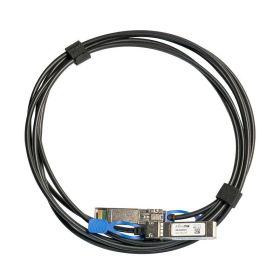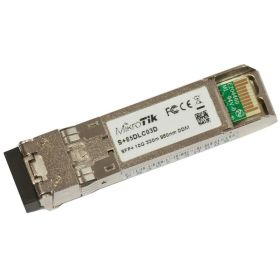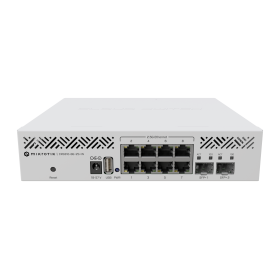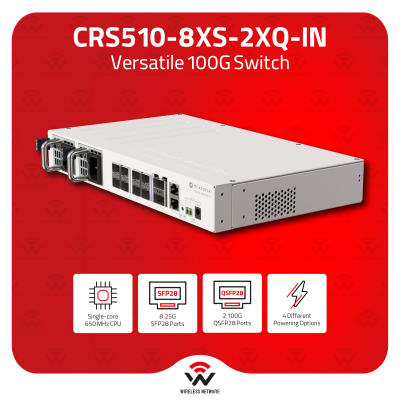


MikroTik CRS510-8XS-2XQ-IN 8×25G SFP28 2×100G Switch
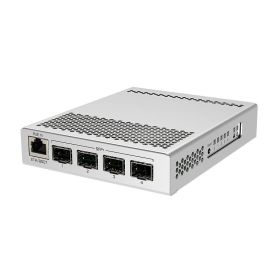
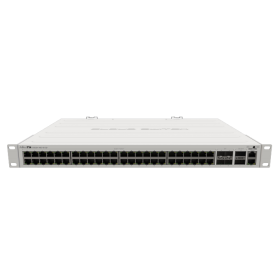
The MikroTik CRS510-8XS-2XQ-IN is a compact 1U 100 Gigabit data centre switch — 8× 25G SFP28 ports + 2× 100G QSFP28 ports, Marvell 98DX4310 Prestera switch ASIC, single-core MIPSBE QCA9531 at 650 MHz, 128 MB RAM, 32 MB FLASH, RouterOS v7 License 5 / SwitchOS (dual-boot), 1× 10/100 Ethernet management port, RJ45 serial console, 5 power input options (2× hot-swap AC PSU slots 100–240V + DC jack 36–57V + 802.3bt PoE-in 42.5–57V + 2-pin terminal 36–57V), 2-fan active cooling, IP20, -40°C to +70°C, MTBF ~200,000 hours at 25°C. CE, EAC, RoHS certified. Includes 2× IEC cord, rack ears for CRS510, K10 screw kit, connector plug.

We only offer IC Certified products. For international products, contact us.

Ship Charge Will Display As Free Until Ship Address / Location Is Provided To Calculate Ship Charge.
The MikroTik CRS510-8XS-2XQ-IN is the third member of MikroTik's 100 Gigabit switch family — following the CRS504-4XQ-IN (4× 100G QSFP28 only) and the CRS518-16XS-2XQ-IN (16× 25G SFP28 + 2× 100G QSFP28) — and occupies the mid-point in that family: 8× 25G SFP28 server-facing ports plus 2× 100G QSFP28 uplink or inter-switch ports, in a compact 1U enclosure. Where the CRS518 targets large-scale 16-server clusters and the CRS504 targets pure 100G interconnect, the CRS510 targets the most common real-world server room scenario: a cluster of 8 servers or storage nodes at 25G, with 100G uplinks to the core.
**The Marvell 98DX4310 — the switch ASIC that makes 100G possible at this price**
The Marvell 98DX4310 is a member of Marvell's Prestera DX switching ASIC family — the same high-performance switch chip lineage used in MikroTik's CRS504 and CRS518. The 98DX4310 provides the hardware switching fabric that simultaneously forwards traffic across all 8× 25G SFP28 ports and 2× 100G QSFP28 ports at line rate. Understanding the 98DX4310's capabilities explains what the CRS510-8XS-2XQ-IN can and cannot do at hardware speed:
- **Hardware-offloaded Layer 2 switching:** VLAN tagging and filtering, MAC address table forwarding, STP/RSTP, LACP 802.3ad link aggregation, QoS queue management, and jumbo frame forwarding — all processed in the 98DX4310 switch ASIC at line rate across all ports simultaneously. A 100G QSFP28 port forwarding traffic to eight simultaneous 25G SFP28 ports — fully utilising all available bandwidth — does not involve the QCA9531 management CPU in the data path.
- **Hardware ACL:** Layer 2, 3, and 4 Access Control Lists implemented in the 98DX4310 ASIC hardware — packet classification and filtering rules evaluated at line rate without CPU overhead. For a server room deployment where traffic isolation between server VLANs, storage VLANs, and management VLANs is enforced at the access layer, hardware ACL provides security policy enforcement at 25G and 100G line rates without performance penalty.
- **MLAG (Multi-chassis Link Aggregation):** MLAG is the standout Layer 2 high-availability feature on the CRS510-8XS-2XQ-IN. MLAG allows two CRS510-8XS-2XQ-IN switches to present as a single logical switch to downstream devices — a server with two 25G NICs can form a single 50G LACP bond that spans both physical switches simultaneously. If one CRS510 fails, the LACP bond continues operating at 25G on the surviving switch without any reconfiguration on the server side. For a high-availability server room where switch failure must not cause server downtime, MLAG across two CRS510-8XS-2XQ-IN units provides active/active redundancy at the access layer. MikroTik explicitly lists MLAG as a supported feature on the CRS510-8XS-2XQ-IN — this is a hardware-assisted Layer 2 high-availability architecture, not a software simulation.
- **L3 hardware offloading:** The 98DX4310 supports some Layer 3 hardware offloading — inter-VLAN routing for established flows is performed in the switch ASIC hardware rather than the QCA9531 CPU. MikroTik's product description notes "some L3 hardware offloading" with deliberate qualification — the scope of L3 offloading on the 98DX4310 at the CRS510's RouterOS configuration level is narrower than a full L3 switch ASIC. For deployments requiring complex multi-VRF routing, BGP, or OSPF at scale, the CRS510-8XS-2XQ-IN should be evaluated as a Layer 2 switch with supplemental L3 capabilities rather than a full Layer 3 router. Use a CCR2004 or RB5009 as the routing layer with the CRS510 as the access/aggregation switch for separation of concerns.
- **Jumbo frames:** Jumbo frame support (typically 9,000 byte MTU) reduces CPU overhead and improves throughput efficiency for storage traffic — iSCSI, NFS, SMB/CIFS over 25G between servers and NAS — and for VM live migration traffic between hypervisors over 25G. In a hyperconverged infrastructure (HCI) cluster where Ceph, vSAN, or Nutanix storage traffic traverses the same 25G fabric as VM compute traffic, jumbo frames are a standard configuration requirement.
**The backward compatibility matrix — what connects to the 8× SFP28 and 2× QSFP28 ports**
MikroTik's product description explicitly highlights "backward compatibility" as a key value — and the port rate support matrix is broad:
**SFP28 ports (8×) — supported rates:**
- **25G (25GBASE-SR, 25GBASE-LR, 25G SFP28 DAC):** The native 25G rate — connecting 25G-capable servers, storage nodes, or downstream switches.
- **10G (10GBASE-SR, 10GBASE-LR, 10G SFP+ DAC):** SFP28 ports are backward compatible with SFP+ transceivers and DAC cables at 10G. For a mixed deployment where some servers have 10G NICs and others have 25G NICs, the CRS510-8XS-2XQ-IN's SFP28 ports serve both simultaneously — no separate 10G switch required.
- **1G (1000BASE-SX, 1000BASE-LX, 1G SFP DAC):** Standard 1G SFP transceivers operate in the SFP28 ports at 1G — backward compatibility extending to legacy Gigabit server connections.
**QSFP28 ports (2×) — supported rates:**
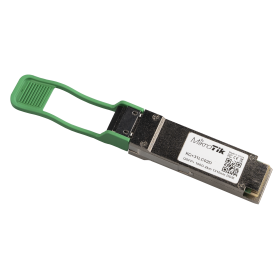
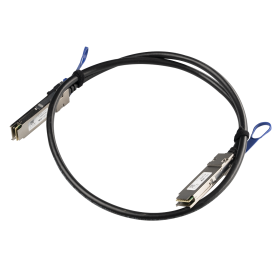
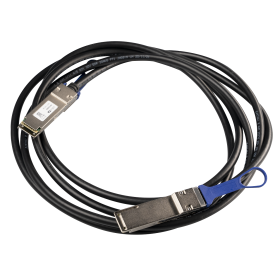
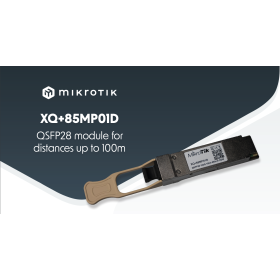
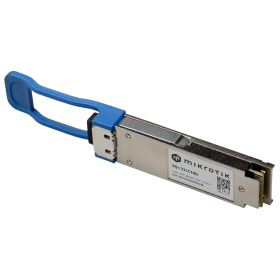
- **100G (100GBASE-SR4, 100GBASE-LR4, 100G QSFP28 DAC/AOC):** The native 100G rate — connecting to a 100G-capable core switch (CRS504-4XQ-IN, CRS518-16XS-2XQ-IN, or a third-party 100G switch), a 100G router, or a 100G NAS.
- **40G (40GBASE-SR4, 40G QSFP+ DAC):** QSFP28 ports are backward compatible with QSFP+ transceivers and DAC cables at 40G — connecting to existing 40G infrastructure without a media converter or adapter.
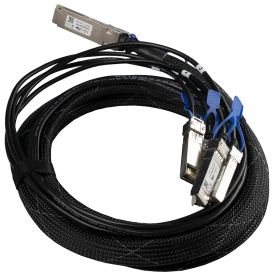
- **25G (with QSFP28 breakout cable to 4× SFP28):** A QSFP28 breakout cable splits one 100G QSFP28 port into four independent 25G SFP28 ports — effectively expanding the CRS510-8XS-2XQ-IN to up to 16× 25G by using both QSFP28 ports as 4× 25G breakouts. This requires a QSFP28-to-4×SFP28 DAC breakout cable and 25G-capable endpoints.
- **10G (with QSFP28 breakout cable to 4× SFP+):** Similarly, a QSFP28-to-4×SFP+ breakout cable provides four 10G SFP+ connections from a single 100G QSFP28 port — a cost-effective way to connect four additional 10G devices from the CRS510's uplink ports.
The backward compatibility across all these rates means the CRS510-8XS-2XQ-IN is a future-ready investment: a server room that currently runs 10G servers can connect them to the SFP28 ports today, add 25G servers as they are deployed, and maintain the existing 10G connections unchanged — all on the same switch simultaneously.
**5 power input paths — the redundancy architecture**
The CRS510-8XS-2XQ-IN's power architecture is the most redundant in this product batch — five independent power input paths:
- **PSU slot 1 — hot-swap AC PSU (100–240V, 47–63 Hz):** The primary AC power supply — a standard IEC cord from a PDU or wall outlet. Hot-swap capable — can be inserted or removed while the switch is operating, without powering down.
- **PSU slot 2 — hot-swap AC PSU (100–240V, 47–63 Hz):** The redundant AC power supply — a second IEC cord from a separate PDU or circuit. The CRS510-8XS-2XQ-IN ships with two IEC cords in the box, confirming that both PSU slots are populated in the standard configuration. With two AC PSUs active, the switch continues operating if either PSU or either AC circuit fails — true N+1 power redundancy without any additional accessories.
- **DC jack (36–57V):** A DC barrel jack for direct DC power input — relevant for data centre deployments running DC power distribution, telecommunications equipment rooms with -48V DC power plants (with appropriate polarity adapter), or rack deployments with DC UPS systems.
- **802.3bt PoE-in (42.5–57V) on the management Ethernet port:** The management Ethernet port accepts 802.3bt (PoE++) power input at 42.5–57V — up to 60W available from an 802.3bt PoE source. For a deployment where an 802.3bt PoE switch is the upstream connection and no separate AC power outlet is available at the rack location, the CRS510-8XS-2XQ-IN can be powered entirely from the management port's 802.3bt PoE-in. This is a genuinely unusual capability for a 25G/100G switch — PoE-powered 25G switching without a separate power outlet.
- **2-pin terminal (36–57V):** A direct DC terminal block for hard-wired DC power — identical in function to the 2-pin terminal on the RB5009UPr+S+OUT. For a permanent installation where a DC power feed is wired directly to the switch rather than using a removable AC cord or barrel connector.
The hot-swap PSU slots are the most operationally significant power feature for data centre and carrier deployments — a failed PSU can be replaced under load without a maintenance window or scheduled downtime. For a production server room where the CRS510-8XS-2XQ-IN is in the data path for active server traffic, PSU hot-swap eliminates one of the most common causes of unplanned switch downtime.
**The management CPU — QCA9531 in a 25G/100G switch**
The QCA9531 single-core MIPSBE at 650 MHz with 128 MB RAM is the same management CPU as the wAP LR2 kit and SXT LTE7 kit — a compact, power-efficient management processor that handles the RouterOS / SwitchOS management plane while the 98DX4310 Prestera ASIC handles the data plane. This architecture — a lightweight management CPU alongside a high-performance switch ASIC — is standard in enterprise and data centre switching: the CPU is never in the data path for normal switching operations. The QCA9531 manages VLAN configuration pushes to the ASIC, processes SNMP polling, handles RouterOS CLI sessions, manages STP/RSTP topology changes, and processes LACP PDUs — all of which are low-bandwidth control plane tasks that 650 MHz single-core MIPS handles comfortably. The 128 MB RAM and 32 MB FLASH are sufficient for RouterOS v7 / SwitchOS management plane operations on a switch of this port count.
**RouterOS v7 License 5 / SwitchOS — dual-boot choice**
RouterOS v7 License 5 on the CRS510-8XS-2XQ-IN provides the full RouterOS management feature set including VLAN, bridge, firewall, SNMP, scripting, and the limited L3 routing capabilities the 98DX4310 supports. SwitchOS provides the streamlined managed switch interface — VLAN configuration, port mirroring, SNMP, link aggregation, and traffic statistics — without RouterOS complexity. For a network administrator managing the CRS510-8XS-2XQ-IN as a pure Layer 2 switch in a larger network infrastructure, SwitchOS's focused UI is the correct operating mode. RouterOS is the correct mode for advanced scripting, automation, and integration into a RouterOS-managed infrastructure.
**The out-of-band management port — 10/100 Ethernet**
The single 10/100 Ethernet management port provides out-of-band management access — a separate management network path that is independent of the 25G and 100G data ports. For a production server room where the CRS510-8XS-2XQ-IN's SFP28 and QSFP28 ports are carrying live server traffic, the 10/100 management port allows VLAN reconfiguration, firmware updates, SNMP monitoring, and CLI access from the management network without touching the data plane. The 802.3bt PoE-in capability on this management port is the power input path that makes PoE-powered operation possible.
**RJ45 serial console — the recovery path**
The RJ45 serial console port provides direct CLI access independent of all Ethernet connections — the essential recovery tool for misconfigured switches. MikroTik's product description specifically highlights: "we've kept the sysadmin's emergency tool: the good old console port." For a network administrator who has accidentally applied a misconfigured VLAN or ACL rule that makes the management Ethernet port unreachable, the serial console provides the recovery path without a factory reset.
**Deployment context — where the CRS510-8XS-2XQ-IN fits**
The CRS510-8XS-2XQ-IN fills a specific and underserved position in the MikroTik switching catalogue: the 8-server 25G access switch with 100G uplink. The canonical deployment scenarios:
- **8-server hyperconverged cluster (25G + 100G uplink):** A Proxmox, VMware vSAN, or Nutanix cluster with 8 servers, each with a 25G NIC, connected to the CRS510-8XS-2XQ-IN's SFP28 ports. The two QSFP28 ports connect via 100G DAC or fiber to a CRS518-16XS-2XQ-IN or a third-party core switch for 100G inter-rack connectivity. MLAG between two CRS510-8XS-2XQ-IN units (one per rack side) provides server-level link redundancy across both switches.
- **ISP aggregation with 100G uplink:** 8 downstream 25G distribution switches connected to the CRS510's SFP28 ports, each distributing to downstream CPE or access switches. Two 100G QSFP28 ports provide uplinks to the ISP core routing platform (CCR2004, CRS518, or a third-party 100G router). Hardware ACL enforces subscriber traffic isolation at the aggregation layer.
- **High-density 25G NAS connectivity:** 8 NAS nodes (Synology, QNAP, or custom TrueNAS/ZFS servers) with 25G Ethernet ports connected to the CRS510's SFP28 ports. The 100G QSFP28 uplinks connect to the compute cluster's access switches — providing 100G aggregated storage bandwidth from 8 NAS nodes to the compute layer. Jumbo frames configured across all SFP28 and QSFP28 ports for maximum storage throughput efficiency.
- **Mixed 10G/25G migration:** An existing 10G server room migrating to 25G — some servers already upgraded to 25G NICs, others still on 10G. The CRS510's SFP28 ports accept both 25G SFP28 and 10G SFP+ transceivers/DAC cables simultaneously, allowing a phased migration without a separate 10G switch for legacy servers. As each server is upgraded to 25G, its switch port automatically operates at the higher rate without port replacement.
**Canadian market note:** Certifications are CE, EAC, and RoHS — no FCC or IC (ISED) published. The CRS510-8XS-2XQ-IN is a wired switch with no wireless transmitter. No ISED wireless device certification advisory applies. Confirm any applicable Canadian electrical safety certification (CSA, cUL) requirements with your distributor before listing. The absence of FCC/IC is not a compliance concern for a wired switch in Canada.
**5-year software support guarantee:** RouterOS v7 and SwitchOS updates free for life of product or minimum 5 years from date of purchase.
Key specifications:
- **Product code:** CRS510-8XS-2XQ-IN
- **Architecture:** MIPSBE
- **CPU:** QCA9531, single-core, 650 MHz
- **Switch ASIC:** Marvell 98DX4310 (Prestera DX)
- **RAM:** 128 MB
- **Storage:** 32 MB FLASH
- **OS:** RouterOS v7 License 5 / SwitchOS (dual-boot)
- **25G SFP28 ports:** 8× (backward compatible: 25G / 10G / 1G)
- **100G QSFP28 ports:** 2× (backward compatible: 100G / 40G / 4×25G breakout / 4×10G breakout)
- **Management Ethernet:** 1× 10/100 Mbps (with 802.3bt PoE-in 42.5–57V)
- **Serial console:** RJ45
- **AC PSU slots:** 2× hot-swap (100–240V, 47–63 Hz) — both populated, 2× IEC cords included
- **DC jack input:** 36–57V
- **2-pin terminal input:** 36–57V
- **PoE-in:** 802.3bt, 42.5–57V (management Ethernet port)
- **Total DC inputs:** 3 (DC jack + PoE-in + 2-pin terminal)
- **Max power consumption:** 45W
- **Max power without attachments:** 27W
- **Cooling:** Active (2 fans)
- **IP rating:** IP20
- **Operating temperature:** -40°C to +70°C
- **MTBF:** ~200,000 hours at 25°C
- **Monitors:** PCB temperature, voltage
- **Key features:** VLAN, ACL, MLAG, jumbo frames, L3 hardware offloading, STP/RSTP, LACP, SNMP
- **Certifications:** CE, EAC, RoHS — no FCC, no IC published
- **Included:** 2× IEC cord, rack ears for CRS510, K10 screw kit, connector plug

- Product code
- CRS510-8XS-2XQ-IN
- CPU core count
- 1
- CPU nominal frequency
- 650 MHz
- Dimensions
- 320 x 185 x 44 mm
- Architecture
- MIPSBE
- Operating Temperature
- -40°C to +70°C
- Size of RAM
- 128 MB
- Storage size
- 32 MB, Flash
- Operating System
- RouterOS v7, License level 5
- Max Power consumption
- 45 W
- Switch chip model
- 98DX4310
- Number of DC inputs
- 3 (PoE-in, DC jack, 2-pin terminal)
- DC jack input Voltage
- 36-57 V
- Max power consumption without attachments
- 27 W
- PoE in input Voltage
- 43-57 V Passive PoE or 802.3bt Class 6
- 10/100 Ethernet ports
- 1
- 2-pin terminal input Voltage
- 36-57 V
- Number of 25G SFP28 ports
- 8
- Number of 100G QSFP28 ports
- 2
General information
All students who attend the Training can receive a free L4 license from MikroTik. Training should be at least three days long.
Students are allowed to take the certification test ONLY upon the attendance of individual training course, in the class, under the supervision of a MikroTik Certified Training Partner.
Each certification test consists of a pre-defined % of random questions (multiple choice and true/false) from specific question categories. Items also have a difficulty parameter. MTCNA test is generated from more straightforward questions, Advanced tests – from more difficult questions.
Only one attempt is allowed. The test must be finished within one hour. The passing grade is set to 60%. There are 25 questions in the exam.
Certificate numbers and RouterOS L4 licenses are assigned automatically by MikroTik. Students can see their certificates and generate license keys once logged into the account server. Printed documents from MikroTik cost USD 30 per piece. Shipping is not included.
Remote training sessions and certification exams are not allowed.
MikroTik Certification Test without prior attendance of particular MikroTik Training Session is not allowed.
Wireless Netware offers every participant a free RouterBOARD hAP-ac-lite.
The price includes class attendance, course materials, coffee breaks and lunch, "Only for local Training." The amount does not cover travel and accommodation expenses.
Please bring (very important): Laptop, power extension strip (10ft./3m) with five sockets, one long Ethernet cable (16ft./5m+) and several short Ethernet cables.
Cost: Early bird price for the course is $850. It is valid 15 days before the scheduled session, referring to the MikroTik Training website. The price will be $1050 after the early bird date. The price includes class attendance, course materials, coffee breaks and lunch," Only for local Training." The amount does not cover travel and accommodation expenses. Seating is limited to only four students. The seat is reserved and guaranteed just after the payment is received in full amount.
Certificates will only be valid for three years.
Become a consultant: It's simple if you have MTCNA (score 75%+) and at least one valid MikroTik Engineer level certificate (MTCRE, MTCWE, MTCTCE, MTCUME or MEDICINE) with score 75%+, apply by email with your mikrotik.com account name and fields of expertise and MikroTik will add you to the list. To stay on the consultant list, you will have to have valid certificates, participate in the MikroTik Forum and attend the ...M.U.M. events in your country conducting RouterOS case studies or workshops for the rest of the attendees.
By purchasing any of "Training Courses," you signify your agreement to these terms and conditions. If you do not agree to these Terms and Conditions, do not use this Site or Service. *WNT may modify this ...T.O.C. at any time and such changes will be effective on the date that such modified ...T.O.C. is posted on this Site. Use of the Site or Service after such changes have taken effect constitutes acceptance of all changes. Training classes, courses, and workshops may be subject to additional notices, class/course descriptions and policies (collectively "Additional Terms"), all of which are made part of this ...T.O.C. by this reference. If there is any conflict between this ...T.O.C. and Additional Terms posted for or applicable to a specific part of Sites such as training course description, the latter supersedes concerning using that particular part of the Site or accurate Service, please read these terms carefully, and keep a copy of them for your reference.
Returns:
All returns to WNT LTD. are handled as exchanges or store credit toward a future purchase. All returns must have a valid ...R.M.A. Number. To request an ...R.M.A. number, log into your account and select. ...R.M.A. from the options menu at the left of your screen. Identify the order and the product you wish to ...R.M.A. and follow instructions on the screen. Once your ...R.M.A. request is received, our ...R.M.A. The team will review your application and respond within two business days or sooner. All products returned for an exchange or store credit must be returned within 30 days of the invoice date. Defective products received by the customer as ...D.O.A. must be reported within seven days. Shipping errors, such as incorrect quantities or incorrect product received, must be reported within seven days. Products purchased from our Clearance Sale, Overstock, Open Box or Special Order (...S.P.O.), or non-stocked items, or custom-assembled products, cannot be returned or exchanged. Order shipments, which arrived damaged, must have a completed. "Damage Parcel Report" with ...U.P.S., USPS, or DHL. All products being returned must be shipped pre-paid. Returns sent C.O.D. will not be accepted and returned to the shipper at the customer's expense. If the repair is under warranty, WNT LTD. will return the product to the customer, within Canada-Post, using Standard Service at no charge. Expedited shipping methods, international shipping costs, customs fees, and duties are the customer's sole responsibility. For non-warranty returns, the customer is responsible for all related shipping costs. All products being returned for store credit must be in the original box with all accessories, warranty cards and instructional sheets, and new, unused condition with the factory seal intact. We do not accept returns for products that have been opened or have missing parts, manuals, warranty cards, or damaged when returned (unless it's ...D.O.A.). A 25% restocking fee will apply. To ensure that the product remains in returnable condition, do not use the product box as the shipping box. You must repackage in another box with appropriate packing materials. Products arriving in a product box will be returned to the shipper at the customer's expense. The customer is responsible for adequately packaging the products returned. Contents of the package not matching the information on the ...R.M.A. form will be cause for the return of ALL equipment.