

MikroTik mANTBox ax 15s AX3000 Dual-Band Sector AP
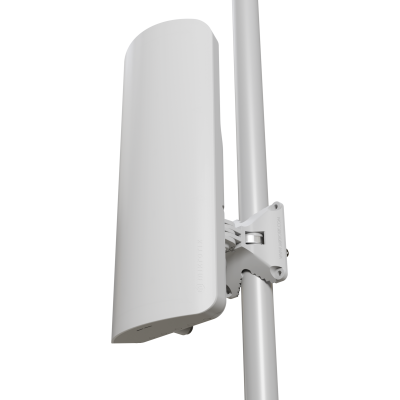
The MikroTik mANTBox ax 15s (L22UGS-5HaxD2HaxD-15S) is a dual-band Wi-Fi 6 outdoor sector antenna base station — AX3000, 2.4 GHz 802.11ax 2-chain 574 Mbps 12 dBi built-in sector antenna (IPQ-5010) + 5 GHz 802.11ax 2-chain 2,400 Mbps 15 dBi built-in sector antenna (QCN-6102), dual-core ARM32 IPQ-5010 at 800 MHz, 256 MB RAM, 128 MB NAND, RouterOS v7 License 4, 1× Gigabit Ethernet with passive PoE-in (18–28V), 1× SFP (2.5G supported), 1× USB 2.0 Type-A (max 1.5A), passive cooling, IP55, -40°C to +70°C, MTBF ~200,000 hours at 25°C. CE, FCC, IC, EAC, RoHS certified. Includes 24V 1.2A power adapter, Gigabit PoE injector, hose clamp, K-41 fastening set, quickMOUNT pro.

We only offer IC Certified products. For international products, contact us.

Ship Charge Will Display As Free Until Ship Address / Location Is Provided To Calculate Ship Charge.
The MikroTik mANTBox ax 15s is the Wi-Fi 6 generation of MikroTik's mANTBox platform — a product line built specifically for outdoor point-to-multipoint (PtMP) sector deployments where a compact AP with a small built-in patch antenna is insufficient, and where a high-gain sector antenna integrated into the AP enclosure is the correct architecture for covering a defined angular sector at distance. The mANTBox platform's defining characteristic is its integrated high-gain sector antenna — the mANTBox ax 15s carries forward that architecture into the Wi-Fi 6 generation with 12 dBi at 2.4 GHz and 15 dBi at 5 GHz.
The 15 dBi 5 GHz built-in sector antenna is the primary performance differentiator versus compact outdoor APs in this price range. A standard outdoor AP with integrated omnidirectional or patch antennas at 4–7 dBi radiates in all directions — gain is distributed across the full azimuth, and the effective EIRP (equivalent isotropically radiated power) in any given direction is modest. The mANTBox ax 15s concentrates its 5 GHz transmit power into a defined sector beam with 15 dBi of antenna gain — significantly more EIRP directed toward client devices within the sector, and significantly less wasted transmit power radiating behind or beside the installation. For a 5 GHz outdoor PtMP deployment where the base station serves CPE units or client devices distributed across a sector at distances of 1–20 km, the 15 dBi sector antenna delivers the link budget that compact APs cannot achieve at these distances.
MikroTik's stated 20 km link reach capability reflects the combined contribution of the 15 dBi sector antenna gain, the 2-chain 802.11ax radio's transmit power, and RouterOS's Nstreme/NV2 wireless protocol optimisations for long-distance outdoor links. The 20 km figure is the maximum feasible link distance under ideal conditions — flat terrain, line-of-sight path clearance with appropriate Fresnel zone clearance, no obstructions, and compatible client-side antenna gain. Real-world deployments should plan conservatively; MikroTik's own product page acknowledges that reliability may vary at longer distances. For ISP last-mile wireless access deployments in rural or semi-rural Canadian environments — flat prairie terrain, lake country, or coastal lowlands — the mANTBox ax 15s's link budget supports client connectivity at distances well beyond what compact APs can achieve.
The dual-band Wi-Fi 6 radio architecture covers both the 2.4 GHz and 5 GHz bands simultaneously from the same sector antenna enclosure:
- 2.4 GHz (802.11b/g/n/ax, 12 dBi, 574 Mbps max): The 2.4 GHz radio with 12 dBi sector antenna provides longer-range coverage for 2.4 GHz-only legacy client devices, IoT sensors, and clients at the outer edge of the 5 GHz coverage footprint where 2.4 GHz penetration is superior. 12 dBi at 2.4 GHz is notably higher gain than standard 2.4 GHz AP antennas — the sector architecture concentrates 2.4 GHz gain into the same horizontal sector as the 5 GHz radio, extending the 2.4 GHz service radius significantly.
- 5 GHz (802.11a/n/ac/ax, 15 dBi, 2,400 Mbps max): The primary high-throughput connectivity tier for 5 GHz Wi-Fi 6 capable clients — CPE subscriber units, outdoor bridges, Wi-Fi 6 mobile devices within range, and fixed wireless terminal adapters. 2,400 Mbps theoretical maximum at 5 GHz with 2-chain 802.11ax OFDMA and MU-MIMO.
Wi-Fi 6's OFDMA (Orthogonal Frequency-Division Multiple Access) is particularly valuable in the mANTBox ax 15s's PtMP sector deployment context. In a PtMP sector serving 20–50 simultaneous client CPE units — an ISP's subscriber base in a rural wireless deployment — OFDMA allows the 5 GHz radio to serve multiple clients simultaneously within a single transmission window, subdividing the channel's subcarrier allocation across clients rather than round-robin time-slicing. The result is more efficient channel utilisation and higher aggregate sector throughput under high subscriber load — the key operational improvement Wi-Fi 6 delivers over Wi-Fi 5 in PtMP subscriber access deployments.
The 2.5G SFP port is the wired uplink differentiator that separates the mANTBox ax 15s from the L11UG-5HaxD and other compact outdoor Wi-Fi 6 APs with only Gigabit Ethernet uplinks. A sector base station serving 20–50 client CPE units, each with a 100 Mbps or higher subscriber plan, can generate aggregate backhaul demand that exceeds 1 Gbps on a busy sector. The 2.5G SFP uplink provides a wired backhaul capacity of 2.5 Gbps — 2.5× the capacity of a Gigabit Ethernet uplink — over a fiber SFP transceiver connected to a 2.5G-capable upstream switch. For a tower-mounted mANTBox ax 15s with fiber backhaul to a POP (point of presence), the 2.5G SFP port ensures the wired backhaul does not become the throughput bottleneck as the sector's subscriber count grows.
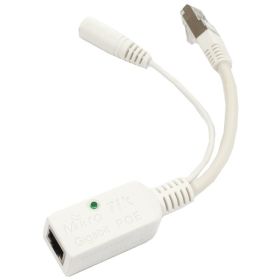
The Gigabit Ethernet port provides passive PoE-in (18–28V) as the alternative power and uplink interface — passive PoE at 18–28V, not 802.3af/at active PoE. This is a critical distinction for Canadian ISP and enterprise customers accustomed to specifying 802.3af/at PoE switches for AP power delivery. The mANTBox ax 15s requires passive PoE at 18–28V on Ether1 — a standard 802.3af/at PoE switch delivering 44–57V active PoE will not correctly power the mANTBox ax 15s without a passive PoE injector at the correct voltage. The included Gigabit PoE injector provides the correct passive PoE voltage from a standard non-PoE switch port. State this power delivery requirement explicitly on the product page: "The mANTBox ax 15s requires passive PoE 18–28V on Ether1 — not 802.3af/at active PoE. Use the included Gigabit PoE injector or a dedicated 18–28V passive PoE injector. The DC jack accepts 12–28V direct DC input."
The USB 2.0 Type-A port (max 1.5A) enables USB LTE modem backup WAN failover — the same USB LTE modem capability as the L11UG-5HaxD and NetMetal ax. For a tower-mounted mANTBox ax 15s sector base station where the primary backhaul is fiber via the SFP port, a USB LTE modem provides automatic WAN failover when the fiber backhaul fails — maintaining subscriber connectivity over cellular during fiber outages. RouterOS's failover scripting detects fiber link failure and switches backhaul traffic to the USB LTE modem without manual intervention. The 1.5A USB port current capacity supports high-current USB LTE modems that standard 0.5A USB ports cannot power reliably.
The quickMOUNT pro wall/pole mount adapter included in the package is a meaningful installation accessory. The quickMOUNT pro provides 140° combined azimuth and elevation adjustment from a fixed mounting point — ±70° in each axis, or distributed between both. For a sector base station where precise antenna alignment to the subscriber population is operationally critical, the quickMOUNT pro's integrated graduated scale allows repeatable, documented alignment settings rather than approximate visual alignment. For a technician aligning the mANTBox ax 15s to a known GPS coordinate for the subscriber cluster, the graduated scale enables precise documented alignment — and simplifies re-alignment after maintenance.
The built-in beeper is a hardware feature worth noting on the product page — RouterOS scripting can trigger the beeper as an audible alert for operator-defined events (link state change, high CPU temperature, WAN failover activation). For a field technician configuring the mANTBox ax 15s at the tower, the beeper can be scripted to confirm successful configuration steps without requiring a connected laptop.
5-year software support guarantee: RouterOS v7 software updates free for life of product or minimum 5 years from date of purchase.
Canadian market note — IC certification confirmed: The mANTBox ax 15s is certified CE, FCC, IC, EAC, and RoHS — IC (ISED) certification is confirmed and published on the product page. This is one of the few MikroTik outdoor wireless devices in this product batch with explicit IC certification. The mANTBox ax 15s can be listed and sold for Canadian wireless operation without an IC certification advisory. Confirm the specific IC certification number from the FCC/IC grant documents linked on the product page for listing purposes.
Key specifications:
- Product code: L22UGS-5HaxD2HaxD-15S
- Architecture: ARM 32-bit
- CPU: IPQ-5010, dual-core ARM32, 800 MHz
- RAM: 256 MB
- Storage: 128 MB NAND
- OS: RouterOS v7, License 4
- Wi-Fi 2.4 GHz: 802.11b/g/n/ax, Wi-Fi 6, 2-chain, 574 Mbps max, 12 dBi built-in sector antenna, IPQ-5010
- Wi-Fi 5 GHz: 802.11a/n/ac/ax, Wi-Fi 6, 2-chain, 2,400 Mbps max, 15 dBi built-in sector antenna, QCN-6102
- Wi-Fi speed class: AX3000 (dual-band)
- Wi-Fi security: WPA3-PSK, WPA3-EAP, OWE, MFP
- Ethernet: 1× 10/100/1000 Mbps, passive PoE-in (18–28V)
- SFP port: 1× (2.5G supported)
- USB: 1× USB 2.0 Type-A, max 1.5A, USB Power Reset
- DC jack input: 12–28V
- Max power consumption: 21W
- Max power without attachments: 11W
- Cooling: Passive
- IP rating: IP55
- Operating temperature: -40°C to +70°C
- MTBF: ~200,000 hours at 25°C
- Monitors: PCB temperature, voltage, beeper
- Certifications: CE, FCC, IC, EAC, RoHS — IC confirmed
- Included: 24V 1.2A power adapter, Gigabit PoE injector, hose clamp, K-41 fastening set, quickMOUNT pro
- Max link reach: Up to 20 km (line-of-sight, conditions dependent)
- Suggested price: USD 179.00

- Product code
- L22UGS-5HaxD2HaxD-15S
- Architecture
- ARM 64bit
- CPU
- IPQ-5010
- CPU core count
- 2
- CPU nominal frequency
- 800 MHz
- Size of RAM
- 256 MB
- Storage size
- 128 MB
- Storage type
- NAND
- Tested ambient temperature
- -40°C to 70°C
- Number of DC inputs
- 2 (DC jack, PoE-IN)
- DC jack input Voltage
- 12-28 V
- Max Power consumption
- 21 W
- Max power consumption without attachments
- 11 W
- Cooling type
- Passive
- PoE in
- Passive PoE
- PoE in input Voltage
- 18-28 V
- SFP ports
- 1 (2.5G supported)
- Voltage Monitor
- Yes
- PCB temperature monitor
- Yes
- Wireless 2.4 GHz Max data rate
- 574 Mbit/s
- Wireless 2.4 GHz number of chains
- 2
- Wireless 2.4 GHz standards
- 802.11b/g/n/ax
- Antenna gain dBi for 2.4 GHz
- 12
- Wireless 2.4 GHz chip model
- IPQ-5010
- Wireless 5 GHz number of chains
- 2
- Wireless 5 GHz standards
- 802.11a/n/ac/ax
- Antenna gain dBi for 5 GHz
- 15
- Wireless 5 GHz chip model
- QCN-6102
- Wi-Fi generation
- Wi-Fi 6
Wi-Fi 6 - Wireless 5 GHz Max data rate
- 2400 Mbit/s
- Certification
- CE, FCC, IC, EAC, ROHS
- IP
- 54
General information
All students who attend the Training can receive a free L4 license from MikroTik. Training should be at least three days long.
Students are allowed to take the certification test ONLY upon the attendance of individual training course, in the class, under the supervision of a MikroTik Certified Training Partner.
Each certification test consists of a pre-defined % of random questions (multiple choice and true/false) from specific question categories. Items also have a difficulty parameter. MTCNA test is generated from more straightforward questions, Advanced tests – from more difficult questions.
Only one attempt is allowed. The test must be finished within one hour. The passing grade is set to 60%. There are 25 questions in the exam.
Certificate numbers and RouterOS L4 licenses are assigned automatically by MikroTik. Students can see their certificates and generate license keys once logged into the account server. Printed documents from MikroTik cost USD 30 per piece. Shipping is not included.
Remote training sessions and certification exams are not allowed.
MikroTik Certification Test without prior attendance of particular MikroTik Training Session is not allowed.
Wireless Netware offers every participant a free RouterBOARD hAP-ac-lite.
The price includes class attendance, course materials, coffee breaks and lunch, "Only for local Training." The amount does not cover travel and accommodation expenses.
Please bring (very important): Laptop, power extension strip (10ft./3m) with five sockets, one long Ethernet cable (16ft./5m+) and several short Ethernet cables.
Cost: Early bird price for the course is $850. It is valid 15 days before the scheduled session, referring to the MikroTik Training website. The price will be $1050 after the early bird date. The price includes class attendance, course materials, coffee breaks and lunch," Only for local Training." The amount does not cover travel and accommodation expenses. Seating is limited to only four students. The seat is reserved and guaranteed just after the payment is received in full amount.
Certificates will only be valid for three years.
Become a consultant: It's simple if you have MTCNA (score 75%+) and at least one valid MikroTik Engineer level certificate (MTCRE, MTCWE, MTCTCE, MTCUME or MEDICINE) with score 75%+, apply by email with your mikrotik.com account name and fields of expertise and MikroTik will add you to the list. To stay on the consultant list, you will have to have valid certificates, participate in the MikroTik Forum and attend the ...M.U.M. events in your country conducting RouterOS case studies or workshops for the rest of the attendees.
By purchasing any of "Training Courses," you signify your agreement to these terms and conditions. If you do not agree to these Terms and Conditions, do not use this Site or Service. *WNT may modify this ...T.O.C. at any time and such changes will be effective on the date that such modified ...T.O.C. is posted on this Site. Use of the Site or Service after such changes have taken effect constitutes acceptance of all changes. Training classes, courses, and workshops may be subject to additional notices, class/course descriptions and policies (collectively "Additional Terms"), all of which are made part of this ...T.O.C. by this reference. If there is any conflict between this ...T.O.C. and Additional Terms posted for or applicable to a specific part of Sites such as training course description, the latter supersedes concerning using that particular part of the Site or accurate Service, please read these terms carefully, and keep a copy of them for your reference.
Returns:
All returns to WNT LTD. are handled as exchanges or store credit toward a future purchase. All returns must have a valid ...R.M.A. Number. To request an ...R.M.A. number, log into your account and select. ...R.M.A. from the options menu at the left of your screen. Identify the order and the product you wish to ...R.M.A. and follow instructions on the screen. Once your ...R.M.A. request is received, our ...R.M.A. The team will review your application and respond within two business days or sooner. All products returned for an exchange or store credit must be returned within 30 days of the invoice date. Defective products received by the customer as ...D.O.A. must be reported within seven days. Shipping errors, such as incorrect quantities or incorrect product received, must be reported within seven days. Products purchased from our Clearance Sale, Overstock, Open Box or Special Order (...S.P.O.), or non-stocked items, or custom-assembled products, cannot be returned or exchanged. Order shipments, which arrived damaged, must have a completed. "Damage Parcel Report" with ...U.P.S., USPS, or DHL. All products being returned must be shipped pre-paid. Returns sent C.O.D. will not be accepted and returned to the shipper at the customer's expense. If the repair is under warranty, WNT LTD. will return the product to the customer, within Canada-Post, using Standard Service at no charge. Expedited shipping methods, international shipping costs, customs fees, and duties are the customer's sole responsibility. For non-warranty returns, the customer is responsible for all related shipping costs. All products being returned for store credit must be in the original box with all accessories, warranty cards and instructional sheets, and new, unused condition with the factory seal intact. We do not accept returns for products that have been opened or have missing parts, manuals, warranty cards, or damaged when returned (unless it's ...D.O.A.). A 25% restocking fee will apply. To ensure that the product remains in returnable condition, do not use the product box as the shipping box. You must repackage in another box with appropriate packing materials. Products arriving in a product box will be returned to the shipper at the customer's expense. The customer is responsible for adequately packaging the products returned. Contents of the package not matching the information on the ...R.M.A. form will be cause for the return of ALL equipment.